
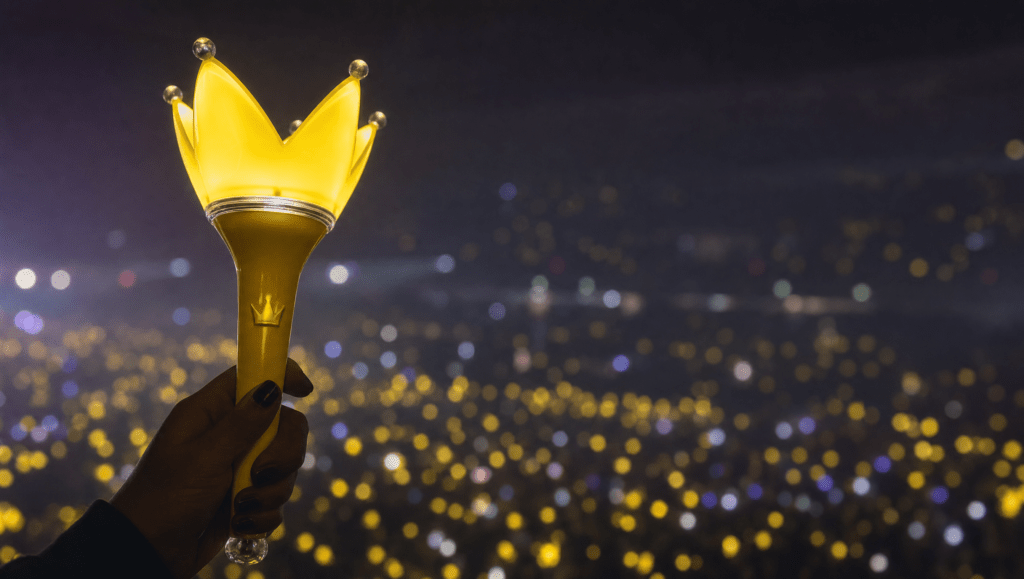
You found BIGBANG a few weeks ago, and somewhere between the old stage clips and a fan comment, two words showed up that you didn’t recognize: Bang Bong. That’s the nickname for the BIGBANG lightstick (the official light a group’s fans wave at concerts), and it also happens to be the one that started everything. The BIGBANG lightstick is widely credited as K-pop’s first official fandom lightstick, the design nearly every group that came after quietly borrowed from. BIGBANG’s fandom, the fans who carry it, are called VIPs, and their stick is where the whole tradition begins.
TL;DR: The BIGBANG lightstick, nicknamed the Bang Bong, is widely credited as K-pop’s first official group lightstick. It appeared in the years after BIGBANG’s 2006 debut, is usually credited to member G-Dragon, and set the template every fandom lightstick has followed since.
What is the Bang Bong?
The Bang Bong is BIGBANG’s official lightstick, and its name is simpler than it looks. “Bong” is the Korean word for a rod or stick, and “Bang” comes from BIGBANG, so Bang Bong reads, roughly, as “the BIGBANG stick.” That naming habit stuck around, and you’ll see it echoed years later in TWICE’s Candy Bong and SEVENTEEN’s Carat Bong, both direct descendants of this one.
The stick itself is easy to spot: it’s a bright yellow handle topped with a small crown, and yellow is BIGBANG’s fandom color. The crown matters more than it seems, because it gave VIPs a shape that was theirs on sight, not just a color shared with a dozen other groups. That single design choice is a bigger deal than it looks, and the next section explains why.
Why the BIGBANG lightstick counts as the first
Concerts were never dark before BIGBANG, because fans already lit up arenas, just in a different way. Early fandoms identified themselves by color, waving a sea of balloons or glow sticks in one assigned shade, like the sapphire blue of Super Junior’s fans. The color told you which fandom filled the room, but the object in everyone’s hand was generic.
The Bang Bong changed the unit: instead of a shared color, BIGBANG gave fans a branded, group-specific object with its own silhouette. That’s the line most people draw when they call it the first official K-pop lightstick, meaning the first light designed as a piece of one group’s identity and sold as official merch. Earlier color codes identified a crowd, while the Bang Bong identified a fandom.
The claim shows up across write-ups of the group’s influence, including South China Morning Post’s roundup of BIGBANG firsts. It’s worth one honest caveat: fan-light culture existed in Japanese pop before this, and pinning an exact “first” is always a little fuzzy. What’s not disputed is the shape of what followed. The idea of one group, one official light, in one unmistakable form, is the model BIGBANG made standard.
The crown, the color, and who designed it
The design is usually credited to G-Dragon, one of BIGBANG’s members and the group’s most visible creative voice. The reported goal was straightforward: he wanted VIPs to stand out in a crowd instead of blending into it. A crown does exactly that, since it reads from across an arena and carries the “top-tier fan” idea baked into the VIP name.
On timing, it’s best to stay honest about the fuzz. The Bang Bong emerged in the years after BIGBANG’s 2006 debut, during the group’s early rise under YG Entertainment. Sources place the exact rollout anywhere from the mid to late 2000s, so a precise launch date is one of those details worth holding loosely: the decade is solid, but the exact day on a calendar is not.
Pro tip: When a fandom fact comes with three different years attached, that’s normal for early K-pop history. Treat the era as reliable and any single exact date as a best guess.
How one lightstick started an entire industry
Once BIGBANG proved fans would buy a light that was theirs, everyone followed: BTS gave ARMY (the BTS fandom) the ARMY Bomb, TWICE gave ONCE the Candy Bong, SEVENTEEN gave CARAT the Carat Bong, and BLACKPINK’s BLINKs got the Bl-Ping-Bong. The “-bong” thread running through half those names is not a coincidence, because it traces straight back to the Bang Bong.
The technology grew up along the way: modern lightsticks pair to an app over Bluetooth, so a venue can control thousands of them at once and turn a crowd into one moving wave of color. The Bang Bong predates most of that, and what it established wasn’t the tech but the expectation that a serious group has an official lightstick, and that fans want the real one.
The format eventually outgrew K-pop entirely, and Western artists now sell their own official lightsticks and app-synced concert lights, borrowing a playbook that traces back to this crown-topped yellow stick. What began as one group’s way to stand out became a standard tool across live pop music.
🔗 Curious what the Bang Bong’s descendants look like now? Browse the current lineup in our official K-pop lightsticks collection.
The 2026 crown: BIGBANG’s 20th Anniversary lightstick
The BIGBANG 20th Anniversary lightstick is the official light YG Entertainment revealed in August 2026 to celebrate twenty years since the group’s 2006 debut. Its full name is the BIGBANG Official Light Stick 20th Anniversary Edition, and while fans and the press call it a new version of the Bang Bong, YG itself doesn’t use the nickname for it.
The silhouette is still a crown, but the palette flips: a white crown head under a clear outer shell, a gold 20th emblem set inside it (BIGBANG’s treble-clef “B”, the number 20 and a repeat sign), a faceted gold ring, a gold button engraved with the same emblem, and a matte black handle. It glows in VIP yellow as well as white, and it runs on AAA batteries, which are not included in the box.
So which crown is yours, the classic or the anniversary one? The yellow Bang Bong is the piece of history this article is about, the shape every fandom after it borrowed. The 20th Anniversary edition is the celebration piece, and its first copies went to VIPs at pop-up stores in Seoul and at the tour’s merch booth in Goyang. If the milestone is what pulled you in, the official BIGBANG 20th Anniversary lightstick is on lightstick.shop at $69.99.
Want a Bang Bong of your own?
If BIGBANG is the group pulling you in, the Bang Bong is a purchase that ages well. It’s a group-level item, so it still means something even if your favorite member shifts over time. Here’s the honest decision rule for a new VIP: for a first Bang Bong, the mini is the smart call. Same crown silhouette and VIP yellow, $29.99 instead of $48.99, and no shelf to clear. The full-size stick is the one you buy when you know you’re heading to a show.
There’s also a G-Dragon route for fans drawn to him specifically: his solo daisy lightstick, styled after his own visual identity rather than the classic crown. All three are below, with live prices pulled today.
🔗 If you’re ready to get your own, the official BIGBANG Bang Bong lightstick is in stock now, with the mini keyring and G-Dragon’s Daisy stick above if you want to compare first.
Every fandom lightstick since has been a variation on one idea BIGBANG had first: give fans a light that’s unmistakably theirs. The Bang Bong just got there before the rest.
FAQ
It is widely credited as the first official K-pop group lightstick, meaning the first light designed as a branded, group-specific object rather than a shared fandom color. Fan lights existed in Japanese pop before it, so an exact first is fuzzy, but the Bang Bong set the model every K-pop fandom lightstick has followed since.
Bong is the Korean word for a rod or stick, and Bang comes from BIGBANG, so Bang Bong reads roughly as the BIGBANG stick. The same naming pattern shows up in later lightsticks like TWICE’s Candy Bong and SEVENTEEN’s Carat Bong.
BIGBANG’s fandom is called VIP, and the Bang Bong’s bright yellow color and crown top were designed to make VIPs stand out in a concert crowd, which is where the crown-and-yellow look comes from.
The design is usually credited to G-Dragon, one of BIGBANG’s members and its most visible creative voice. The reported idea was to give VIPs a shape that stood out in a crowd rather than blending into a wall of one color.
The Bang Bong came first by years, since BIGBANG debuted in 2006 and their lightstick appeared in that era, while the BTS ARMY Bomb arrived in the mid-2010s. In lightstick terms, the ARMY Bomb is a descendant of the model BIGBANG established.


Pingback: K-pop Lightstick List: Every Group (Updated 2026)
Pingback: Gifts for K-pop Fans: What to Buy When You’re Not One – Lightstick Blog